Will a supplement raise your HRV?
Probably not
On this page
Probably not by much. Across 15 trials of fish oil, the time-domain measures wearables report didn’t change. The magnesium evidence comes down to one trial of 100 people. Fewer drinks, earlier dinners, enough sleep and steady training all have far better evidence for moving your number.
What we’d do
Skip supplements bought for HRV. Put the money and the effort into the habits that move it. If you take a supplement for another reason your doctor agrees with, fine, but don’t expect your ring to notice.
If you remember three things
- Fish oil didn’t move RMSSD-type measures. Across 15 trials, only one frequency measure rose.
- Magnesium rests on very little. One trial of 100 people, in a German practice journal.
- Habits move it more. One drink more than usual, against one fewer, came with HRV 3 to 4 ms lower that night.
Why it sounds plausible
Supplements are sold for everything the body does, and HRV feels like a body number that should respond to the right nutrient. Magnesium in particular is sold as calming. A capsule is easier than giving up the evening glass of wine.
Will a lighter bike get you up a hill full of bricks?
A little. A lighter frame does help on a climb. But if you’ve loaded the bike with bricks, taking the bricks off matters far more than the frame. For HRV, the bricks are things like the drinks, the late dinners, the short nights and the hard workouts right before bed.
What the studies show
Fish oil. A 2013 review pooled 15 randomized trials. Fish oil didn’t significantly change SDNN or the successive-difference measure closest to RMSSD. One frequency measure linked to the vagus nerve rose by a small amount. The trials were short.
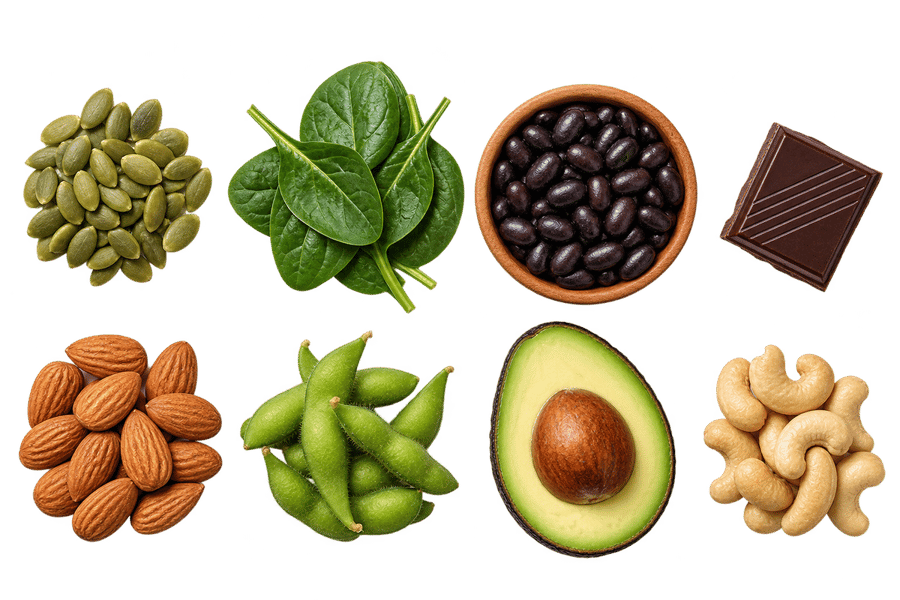
Magnesium. A 2016 trial gave 100 people 400 mg of magnesium a day for 90 days, together with a strength and endurance training program. A measure of beat-to-beat variation (pNN50) rose in the magnesium group, with no such change in the control group. That’s one trial, published in a German practice journal. It also reported a lower LF/HF ratio, a frequency measure that a 2026 guideline says shouldn’t be used as a marker of nervous system balance. A smaller 2009 study of 16 people with heart failure found a rise in one complex HRV measure after 5 weeks of 300 mg a day. Neither tells you much about a healthy person’s ring.
How the habits compare
| Change | Size |
|---|---|
| One drink more than usual, against one less | HRV 3.8 ms lower in women, 3.3 ms in men, in 20,968 WHOOP members |
| A day of tobacco use | HRV 3.5 ms lower in 12,678 WHOOP members |
| Last meal 3 or more hours before sleep | Higher night HRV in a 7.5-week trial of 39 adults |
| Regular exercise | A moderate rise in a vagal HRV measure across 13 studies |
| Sleep loss | Lower RMSSD across 11 trials |
| Fish oil | No change in time-domain measures across 15 trials |
The best case for supplements
“Some people are low in magnesium, and fixing a shortage should help.” That may be true for someone with a real shortage, and a doctor can test for one. But the trials above weren’t designed to show that.
How to test one on yourself
- Build your usual range over two to three weeks on one device.
- Take the supplement for two weeks and change nothing else: same drinks, same bedtime, same training.
- Stop for two weeks.
- Compare the 7-day averages. If the supplement weeks don’t sit clearly above the others, you have your answer.
Before starting any supplement, check with your doctor or pharmacist if you take medicines or have a health condition.
9 sources
- Xin W, Wei W, Li XY, Short-term effects of fish-oil supplementation on heart rate variability in humans: a meta-analysis of randomized controlled trials, American Journal of Clinical Nutrition, 2013pubmed.ncbi.nlm.nih.gov
- Wienecke E, Nolden C, Long-term HRV analysis shows stress reduction by magnesium intake, MMW Fortschritte der Medizin, 2016pubmed.ncbi.nlm.nih.gov
- Almoznino-Sarafian D et al., Magnesium administration may improve heart rate variability in patients with heart failure, Nutrition, Metabolism and Cardiovascular Diseases, 2009pubmed.ncbi.nlm.nih.gov
- Carter JR et al., Guidelines for rigor and reproducibility of heart rate variability within human cardiovascular research, American Journal of Physiology Heart and Circulatory Physiology, 2026pubmed.ncbi.nlm.nih.gov
- Grosicki GJ et al., Real-world effects of alcohol on heart rate, sleep, and physical activity by age and sex, PLOS Digital Health, 2026pubmed.ncbi.nlm.nih.gov
- Curran DJ et al., Tobacco use trajectories and associated changes in biometrics and sleep during the first 72 weeks of wearable membership, JMIR mHealth and uHealth, 2026pubmed.ncbi.nlm.nih.gov
- Grimaldi D et al., Sleep-aligned extended overnight fasting improves nighttime and daytime cardiometabolic function, Arteriosclerosis, Thrombosis, and Vascular Biology, 2026pubmed.ncbi.nlm.nih.gov
- Sandercock GR, Bromley PD, Brodie DA, Effects of exercise on heart rate variability: inferences from meta-analysis, Medicine and Science in Sports and Exercise, 2005pubmed.ncbi.nlm.nih.gov
- Zhang S et al., Effects of sleep deprivation on heart rate variability: a systematic review and meta-analysis, Frontiers in Neurology, 2025pubmed.ncbi.nlm.nih.gov