What does Apple Watch HRV mean?
On this page
- Why is my Apple Watch HRV so different from my ring?
- A simple way to picture it
- What does Apple Watch measure, and when?
- What do Recovery HRV and overall HRV mean?
- How accurate is Apple Watch HRV?
- Is Apple Watch HRV useful at all?
- What’s a normal Apple Watch HRV?
- How should I use my Apple Watch HRV?
- Track it in Gyroscope
Apple Watch has long reported HRV as SDNN, from short samples it takes a few times a day and night. Oura, WHOOP and Garmin report RMSSD, a different calculation, so never compare the two. Series 12 and Ultra 4 add Recovery HRV.
If your Apple Watch and your ring disagree, that’s expected. If your watch jumps from one sample to the next, that’s expected too. Both come from how and when the watch measures.
What we’d do
Compare your Apple Watch only with itself. Use the samples taken while you sleep, or Recovery HRV in Vitals if you have a Series 12 or Ultra 4, and judge the weekly average, not single samples. Keep Recovery HRV as its own history, apart from your older SDNN samples, until Apple says how it’s calculated. If you wear a ring too, keep two histories and never average them.
If you remember three things
- It’s SDNN. It can’t be compared with, or converted to, the RMSSD on a ring or strap.
- It runs low and noisy against a chest strap. About 8 ms low on average, and single tests about 20 ms off, in a 2024 study.
- Recovery HRV is new and unexplained. Apple hasn’t said which calculation it uses.
Why is my Apple Watch HRV so different from my ring?
Three reasons, and any one of them is enough.
- A different calculation. Apple’s developer documentation says HealthKit “uses SDNN heart rate variability, which uses the standard deviation of the inter-beat (RR) intervals between normal heartbeats.” Rings and straps use RMSSD, which looks at how much each gap differs from the one before. The same beats give different answers, and no formula turns one into the other. How the two differ.
- Different moments. A ring averages five-minute samples across the whole night. Older Apple Watches take a short sample every few hours, so a sample at 3 am in deep sleep and one at 3 pm at your desk are two very different situations.
- Different sensors and processing. Each company cleans up the pulse signal its own way.
The same goes for why your watch seems to jump around. A sample taken while you were still and one taken after climbing the stairs aren’t measuring the same state.
A simple way to picture it
Older Apple Watches take photos. A ring films the whole night. A photo can catch you at a calm moment or a busy one, so photos taken hours apart vary a lot. A film of the whole night averages all of that out.
Series 12 takes far more photos, as often as every five minutes. That makes the picture much closer to a film.
What does Apple Watch measure, and when?
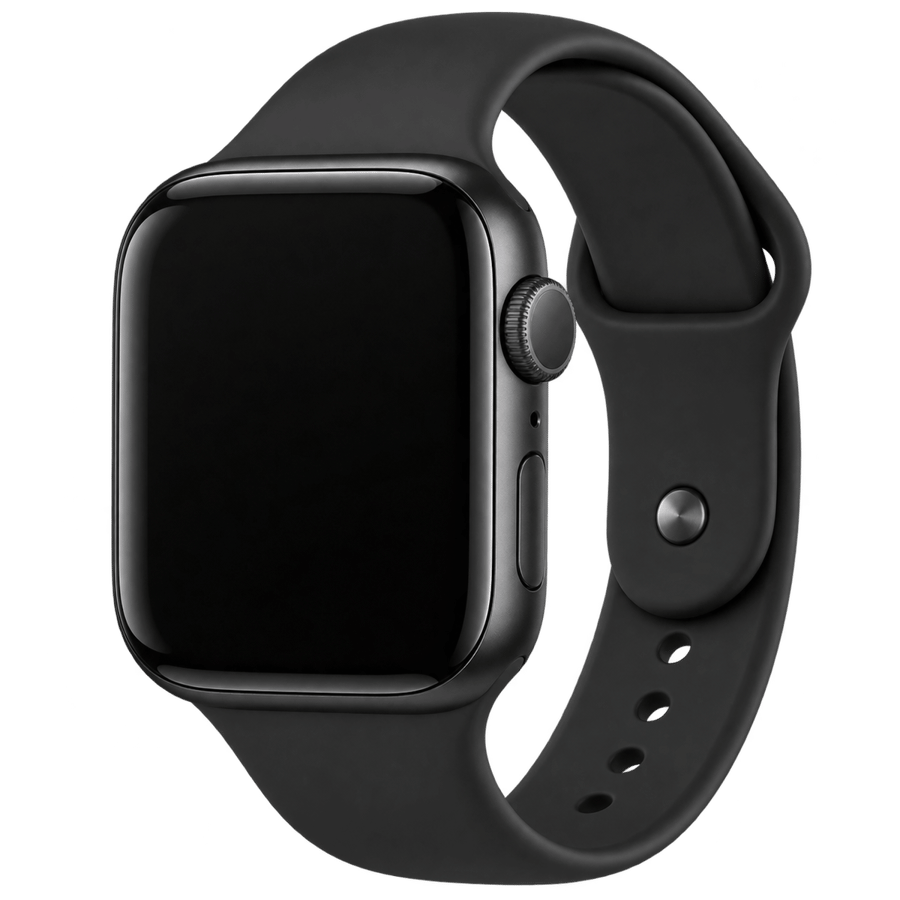
- The sensor times your pulse. Green light on the back of the watch picks up each pulse in your wrist. That’s pulse rate, not the electrical beat an ECG records.
- The watch takes short samples. On models before Series 12, a 2024 study described these as coming every two to four hours, day and night.
- You can ask for one. A Breathe session records a sample, and researchers testing the watch used it to measure on demand.
- Each sample becomes one SDNN value. These go into the Health app as heart rate variability, in ms.
- Series 12 and Ultra 4 measure much more often. Apple says HRV is now measured “as often as every five minutes,” about 24 times more often than before. Series 12 also measures heart rate every five seconds.
What do Recovery HRV and overall HRV mean?
On Series 12 and Ultra 4, Apple shows HRV two ways. In Apple’s words, “Recovery HRV is best for identifying daily signals of stress and recovery,” and “overall HRV is best for insights into a user’s broader health, including cardiovascular health.”
Apple hasn’t said how either is calculated, which part of the day or night each uses, or how either relates to the SDNN samples the watch has always recorded. Its developer documentation now lists a new HealthKit type for RMSSD, introduced with iOS and watchOS 27, with no description when we checked in November 2026. It’s tempting to guess that Recovery HRV is RMSSD. Until Apple says so, we’d treat it as a new series of its own.
| What you see | What it is | Which watches |
|---|---|---|
| Heart rate variability in Health | SDNN samples, in ms | All models that measure HRV |
| Recovery HRV | A new HRV measure for daily stress and recovery, compared with your own baseline in Vitals. Calculation not published | Series 12 and Ultra 4 |
| Overall HRV | A new HRV measure for longer-term heart health. Calculation not published | Series 12 and Ultra 4 |
| Vitals, overnight | Your overnight metrics against your typical range. On Series 12 and Ultra 4, HRV takes the place of sleep duration | Watches running current watchOS, with sleep tracking on |
| Vitals, daytime | Resting heart rate and HRV during the day | Series 12 and Ultra 4 |
| Readiness | A 0 to 10 score from your recent activity, training load, vitals and sleep score, with four labels: Recover, Pace Yourself, Ready, Go For It | Series 12 and Ultra 4 |
A few details from Apple’s support page are worth knowing. Vitals needs you to wear the watch to sleep for 7 days to set your typical range. If several metrics fall outside it, you get a notification the next morning. And Apple says Vitals “measurements are not intended for medical use.”
How accurate is Apple Watch HRV?
Moderate We’re fairly confident older Apple Watches give SDNN values that run low and vary a lot from a chest strap on any one test. Unknown No independent study of Series 12 HRV has been published yet that we could find.
Series 9 and Ultra 2 against a chest strap
39 healthy adults, 316 paired five-minute tests lying down each morning for 14 days. O’Grady, Sensors, 2024
The watch came in 8.31 ms lower than a Polar H10 strap on average. Single tests were off by 20.46 ms on average, or 28.9 percent. Resting heart rate was almost exactly right, within 0.08 beats a minute on average.
Guided Breathe sessions, not the background or overnight samples most people look at.
Series 6 against a lab ECG
78 healthy adults aged 20 to 75, in a lab. Bonneval, Sensors, 2025
At rest the watch timed beats almost perfectly, with a 1.15 percent error. But agreement on the gaps used for HRV was only moderate, with a 31.31 percent error, and it was worse in the other conditions they tested, such as talking.
An older model, and short guided sessions.
Every Apple Watch study, counted
82 validation studies, 430,052 people, searched to September 2025. Lambe, NPJ Digital Medicine, 2026
Heart rate had been checked in 38 studies. HRV had been checked in one.
A review counts studies. It doesn’t test the watch.
That second study shows the problem in miniature. The watch gets the heart rate right and the HRV less right. HRV is built from differences of a few milliseconds between gaps, so a timing error of a few milliseconds on each pulse is a large share of the answer.
Is Apple Watch HRV useful at all?
The sceptic says
It’s too noisy to mean anything. Single tests off by about 20 ms, nearly 30 percent, is too much error to trust one number.
SDNN is the wrong choice for short samples. In 3,387 adults, RMSSD held up better than SDNN at every recording length, from 10 seconds to two minutes.
The reply
For one sample, yes. For a trend, less so. In health care workers wearing Apple Watches, the daily pattern of SDNN changed in the week before a COVID diagnosis. Averaging many samples over a week cuts the noise, which is why we’d always look at the weekly average.
That’s fair. It’s a real reason Apple’s numbers swing, and another reason to judge many samples together rather than one.
What’s a normal Apple Watch HRV?
We haven’t found a well-documented published table of Apple Watch SDNN by age. Tables built from RMSSD, from rings, straps or medical recorders, don’t apply to your watch. Apple’s own approach in Vitals is the right one: compare you with your own typical range.
How should I use my Apple Watch HRV?
- Use the samples from sleep, or Recovery HRV in Vitals. Daytime samples depend on what you were doing.
- Judge the weekly average. In a study of 10 runners, the weekly average tracked fitness gains closely and single days barely did.
- Keep your histories apart. Old SDNN samples, Recovery HRV on a Series 12, and a ring’s RMSSD are three different series.
- For a precise morning number, use a chest strap. Lie still for five minutes each morning on waking, the way the 2024 study did, and keep those numbers separate too.
- Don’t look for Oura’s HRV in Apple Health. Oura’s list of what it writes to Apple Health doesn’t include HRV, so the HRV you see there comes from your watch or another app.
If your HRV jumps far above your usual and you feel your heart racing, fluttering or skipping, see a doctor. Irregular beats can look like high variability.
Track it in Gyroscope
Connect an Apple Watch and every night’s HRV lands in Gyroscope on its own, charted against your own normal. Apple Watch’s SDNN and the RMSSD from Oura, WHOOP and Garmin are kept apart and never averaged, and your sleep, resting heart rate and drinks sit beside it. See tracking it in Gyroscope.
14 sources
- Apple Developer, heartRateVariabilitySDNN, HealthKit documentation, checked 2026-11-10developer.apple.com
- Apple Developer, heartRateVariabilityRMSSD, HealthKit documentation, listed for iOS and watchOS 27, checked 2026-11-10developer.apple.com
- Apple Newsroom, Introducing Apple Watch Series 12, with the all-new Health Sensing System, 2026-09-09apple.com
- Apple Newsroom, Apple advances health and fitness capabilities using Apple Intelligence, 2026-09-09apple.com
- Apple Support, Track your overnight and daytime vitals with Apple Watch, checked 2026-11-10support.apple.com
- O'Grady et al., The validity of Apple Watch Series 9 and Ultra 2 for serial measurements of heart rate variability and resting heart rate, Sensors, 2024pmc.ncbi.nlm.nih.gov
- Bonneval et al., Validity of heart rate variability measured with Apple Watch Series 6 compared to laboratory measures, Sensors, 2025pmc.ncbi.nlm.nih.gov
- Lambe et al., The accuracy of Apple Watch measurements: a living systematic review and meta-analysis, NPJ Digital Medicine, 2026pmc.ncbi.nlm.nih.gov
- Hirten et al., Use of physiological data from a wearable device to identify SARS-CoV-2 infection and symptoms and predict COVID-19 diagnosis, Journal of Medical Internet Research, 2021pmc.ncbi.nlm.nih.gov
- Munoz et al., Validity of (ultra-)short recordings for heart rate variability measurements, PLOS ONE, 2015pmc.ncbi.nlm.nih.gov
- Ben-David et al., Pulse rate variability is not the same as heart rate variability, Sports Medicine Open, 2026pmc.ncbi.nlm.nih.gov
- Oura Member Care, Apple Health Integration, the data Oura writes to Apple Health, updated 2026-10-14support.ouraring.com
- Shaffer and Ginsberg, An overview of heart rate variability metrics and norms, Frontiers in Public Health, 2017pmc.ncbi.nlm.nih.gov
- Plews et al., Evaluating training adaptation with heart-rate measures: a methodological comparison, International Journal of Sports Physiology and Performance, 2013pubmed.ncbi.nlm.nih.gov