How do you measure HRV?
On this page
- Why do my ring and my watch give different numbers?
- A simple way to picture it
- Twelve gaps between beats, two numbers
- Which device measures what?
- Is night or morning the better time?
- How accurate are watches and rings?
- Should I use the average or the highest number?
- What changes the measurement without changing you?
Your device times the gap between each pair of heartbeats, then sums hundreds of gaps up in one number. Apple Watch uses a calculation called SDNN. Oura, WHOOP and Garmin use RMSSD. Measure at night, every night, on one device.
The two calculations answer different questions about the same beats, so a watch and a ring can give very different numbers for the same night. Neither is wrong, and there’s no way to convert one into the other.
What we’d do
Wear one device to bed every night and use its overnight average. Ignore the maximum, which is your single best five minutes. If you switch devices, start a new history and give it a few weeks. If you want a morning check too, use a chest strap lying still for five minutes, and keep those numbers in their own column.
If you remember three things
- SDNN and RMSSD can’t be converted. The same beats can give the same SDNN and very different RMSSD.
- Night is the fairest test for most people. You’re still, lying down and in a similar state each time.
- Watches and rings measure your pulse, not the beat itself. They usually come in lower than a chest strap.
Why do my ring and my watch give different numbers?
It’s one of the most common questions. You wear an Oura ring and an Apple Watch on the same night and get two numbers that aren’t close. One of them must be broken.
Usually neither is. They differ for three reasons, and each one alone can change the number a lot.
- Different math. Apple Watch reports SDNN. Oura, WHOOP and Garmin report RMSSD.
- Different stretches of time. Apple Watch takes short samples. Oura averages five-minute samples across the night. WHOOP weights its average toward deep sleep and later in the night. Garmin averages the whole sleep.
- Different sensors and processing. Each company filters out bad beats its own way, and not all of them say how.
A simple way to picture it
Shoe sizes. A 9 in one brand can fit like a 10 in another. Your size in one brand is very useful for buying that brand again, and close to useless for comparing your feet with a friend’s in another brand.
HRV is the same. Your number on your device is a good guide to your own nights. It’s a poor guide to anyone else’s, or to your own on a different device.
Twelve gaps between beats, two numbers
Here are twelve resting gaps between beats, in milliseconds: 980, 1010, 1040, 1060, 1030, 990, 960, 950, 980, 1020, 1050, 1040. The average gap is about 1,009 ms, a heart rate of about 59.5 beats a minute. The gaps rise and fall with breathing, which is normal.
- SDNN asks how widely the gaps spread. It takes all twelve, finds their average and works out the standard deviation around it. Here SDNN is 36.5 ms.
- RMSSD asks how much each gap differs from the one before. It takes the eleven differences (30, 30, 20, minus 30, minus 40, minus 30, minus 10, 30, 40, 30, minus 10), squares them, averages them and takes the square root. Here RMSSD is 28.9 ms.
- Now shuffle the same twelve gaps. Put them in this order: 980, 1060, 950, 1050, 960, 1040, 990, 1030, 1010, 1020, 1040, 980. The spread hasn’t changed, so SDNN is still 36.5 ms.
- RMSSD more than doubles. The neighbouring gaps now jump back and forth, and RMSSD is 68.5 ms.
That’s why no formula turns one into the other. SDNN doesn’t care about the order of the beats. RMSSD is built from the order. A number on your screen has already thrown the order away.
The two also behave differently with time. SDNN picks up slow drifts across a recording, so a longer recording gives it more to find. RMSSD mostly follows the fast, breath-by-breath changes the vagus nerve makes, which show up in seconds.
Which device measures what?
| Device | Calculation | When it measures | What you see |
|---|---|---|---|
| Apple Watch | SDNN. Apple hasn’t said how Recovery HRV on Series 12 and Ultra 4 is calculated | Short samples through the day and night, and during a Breathe session, which researchers use to take one on demand. Series 12 measures as often as every five minutes | Samples in the Health app. Recovery HRV in Vitals on the newest models |
| Oura | RMSSD | Five-minute samples during sleep, plus some guided sessions | Night average and maximum, and HRV Balance |
| WHOOP | RMSSD | Overlapping five-minute windows all night, with wake removed and more weight on likely deep sleep and later in the night | One value for the night, inside Recovery |
| Garmin | RMSSD | The whole sleep, charted in five-minute windows | Last night’s average, the 7-day average and HRV Status |
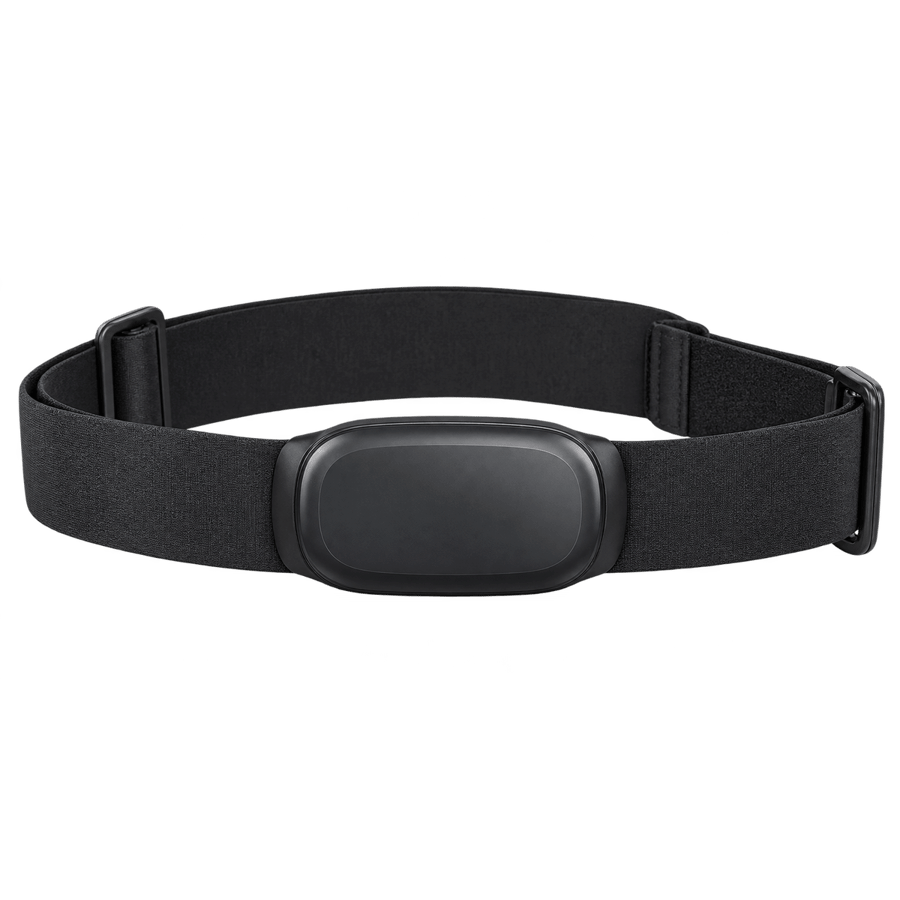
| Chest strap with an app | Whatever the app calculates, often both | When you start a recording | Depends on the app |
Is night or morning the better time?
For most people, night. You’re lying down, still and asleep, so one night is a fair match for the next. Oura measures HRV only during sleep, it says, “to ensure the most reliable and interpretable data.” Garmin uses the whole night and calls that an advantage over methods that measure only part of it.
A morning check is the other good option, and it’s how the training trials we cite measured HRV, every morning. The rules that make it work:
- Same time, same position, every day. Researchers testing the Apple Watch had people lie still for five minutes each morning on waking.
- Breathe normally. Slow breathing raises HRV while you do it, so a breathing session isn’t a resting check.
- A few minutes is enough for RMSSD. In 3,387 adults, RMSSD from two minutes agreed almost perfectly with five, and even ten seconds gave a usable value. RMSSD held up better than SDNN at every length tested.
- Keep it apart. A morning number and a night number are two different measurements, even from the same device.
Daytime samples are the least useful for tracking. In a lab test of the Apple Watch, agreement with ECG was best at rest and worse with talking and walking, and an afternoon sample at your desk isn’t comparable with a night.
How accurate are watches and rings?
Good enough to follow your own trend, and less accurate than an ECG for any single number.
A chest strap measures the electrical signal of each beat. A watch or ring shines light into the skin and times the pulse as it arrives. Garmin calls its own measurement “pulse rate variability” for that reason. In 103 college athletes, the pulse-based RMSSD averaged 81 ms against 104 ms from ECG on the same recordings, and caught only 17 to 57 percent of the changes the ECG flagged, 1.8 to 5.5 days late.
Five devices against an ECG, overnight
13 adults, 536 nights. Dial, Physiological Reports, 2025
Agreement with ECG for overnight RMSSD: Oura Gen 4 0.99, Oura Gen 3 0.97, WHOOP 4.0 0.94, Garmin Fenix 6 0.87, Polar Grit X Pro 0.82. Average errors ran from about 6 percent for Oura Gen 4 to 16 percent for Polar.
A small group. The comparison used an all-night average, which WHOOP’s own researchers say isn’t how WHOOP calculates its number.
Apple Watch against a chest strap
39 adults, 316 paired five-minute morning tests. O’Grady, Sensors, 2024
Series 9 and Ultra 2 came in 8.31 ms lower on average, and single tests were off by about 20 ms, or 29 percent.
These were guided morning sessions, not background or overnight samples.
Oura in a sleep lab
114 adults with an ECG overnight. Liang, Sensors, 2024
Oura’s RMSSD matched ECG well when bad stretches were thrown out and the values were averaged over at least 30 minutes.
More than half the older participants still had errors over 10 percent.
These studies tested accuracy against an ECG, which is a different question from whether a device tracks your own changes. A device that runs low by a steady amount can still show your trend, though the athlete study above found the pulse-based number missed many short changes. That’s one more reason to judge a week, not a night.
Should I use the average or the highest number?
The average. Oura and Garmin both show your highest five-minute value of the night. It’s one window out of the whole night, so any single good or bad stretch moves it, and irregular beats can push it up.
Gyroscope’s old guide said both the average and the highest number were useful. We’d now use the average alone for tracking.
What changes the measurement without changing you?
- A new device, model or wear spot. Start a new history.
- A loose fit or poor contact. In the Oura sleep lab study, the number only matched ECG well when most beats in each window were clean.
A 2026 guideline paper from heart researchers lists the input signal, the length of the recording, where it’s taken, breathing and the method of analysis as things that all change HRV results.
The formulas
For a series of N normal-to-normal gaps between beats, in ms:
- SDNN is the standard deviation of the gaps: the square root of the average squared distance of each gap from the mean gap.
- RMSSD is the square root of the mean of the squared differences between each gap and the next.
- pNN50 is the share of neighbouring gaps that differ by more than 50 ms.
The 1996 European and North American task force set these definitions. Many training studies, including the 2013 study of 10 runners, use the natural log of RMSSD (ln RMSSD) instead of RMSSD itself.
21 sources
- Task Force of the European Society of Cardiology and the North American Society of Pacing and Electrophysiology, Heart rate variability: standards of measurement, physiological interpretation and clinical use, Circulation, 1996pubmed.ncbi.nlm.nih.gov
- Shaffer and Ginsberg, An overview of heart rate variability metrics and norms, Frontiers in Public Health, 2017pmc.ncbi.nlm.nih.gov
- Munoz et al., Validity of (ultra-)short recordings for heart rate variability measurements, PLOS ONE, 2015pmc.ncbi.nlm.nih.gov
- Apple Developer, heartRateVariabilitySDNN, HealthKit documentation, checked 2026-11-10developer.apple.com
- Oura Member Care, Heart Rate Variability, updated 2026-10-01support.ouraring.com
- Oura, West Virginia University validates Oura, on rMSSD in the Oura app, 2021ouraring.com
- WHOOP for Developers, Recovery, the hrv_rmssd_milli field, checked 2026-11-10developer.whoop.com
- WHOOP Community, HRV extreme spikes, reply from WHOOP's data science team lead on how nightly HRV is calculated, 2025-08-13community.whoop.com
- Garmin, HRV Status, Garmin Technology, checked 2026-11-10garmin.com
- Ben-David et al., Pulse rate variability is not the same as heart rate variability, Sports Medicine Open, 2026pmc.ncbi.nlm.nih.gov
- Dial et al., Validation of nocturnal resting heart rate and heart rate variability in consumer wearables, Physiological Reports, 2025pmc.ncbi.nlm.nih.gov
- O'Grady et al., The validity of Apple Watch Series 9 and Ultra 2 for serial measurements of heart rate variability and resting heart rate, Sensors, 2024pmc.ncbi.nlm.nih.gov
- Liang, Yilmaz and Soon, Deriving accurate nocturnal heart rate, rMSSD and frequency HRV from the Oura Ring, Sensors, 2024pmc.ncbi.nlm.nih.gov
- Bonneval et al., Validity of heart rate variability measured with Apple Watch Series 6 compared to laboratory measures, Sensors, 2025pmc.ncbi.nlm.nih.gov
- Grosicki and Presby, Accurate comparison of wearables requires contextual equivalence, Physiological Reports, 2025pmc.ncbi.nlm.nih.gov
- Kiviniemi et al., Endurance training guided individually by daily heart rate variability measurements, European Journal of Applied Physiology, 2007pubmed.ncbi.nlm.nih.gov
- Vesterinen et al., Individual endurance training prescription with heart rate variability, Medicine and Science in Sports and Exercise, 2016pubmed.ncbi.nlm.nih.gov
- Plews et al., Evaluating training adaptation with heart-rate measures: a methodological comparison, International Journal of Sports Physiology and Performance, 2013pubmed.ncbi.nlm.nih.gov
- Laborde et al., Effects of voluntary slow breathing on heart rate and heart rate variability: a systematic review and a meta-analysis, Neuroscience and Biobehavioral Reviews, 2022pubmed.ncbi.nlm.nih.gov
- Carter et al., Guidelines for rigor and reproducibility of heart rate variability within human cardiovascular research, American Journal of Physiology Heart and Circulatory Physiology, 2026pubmed.ncbi.nlm.nih.gov
- Apple Newsroom, Introducing Apple Watch Series 12, with the all-new Health Sensing System, 2026-09-09apple.com