What is heart rate variability?
On this page
Heart rate variability (HRV) is how much the time between your heartbeats changes from one beat to the next, measured in milliseconds (ms). At rest, more change usually means your body is rested. Less usually means something is asking it to stay busy.
At 60 beats a minute, your heart doesn’t beat once every second like a clock. One gap might be 0.95 seconds and the next 1.05. HRV is a single number that sums up how much those gaps move.
What we’d do
Think of your HRV as a measure of how much your heart’s brake is working at rest. When you’re rested it works a lot, and the number is high for you. Drinks, a hard late workout or a cold on the way take the brake off, and the number falls. Use it to learn what last night did to you, not to grade yourself against anyone else.
If you remember three things
- Uneven is normal at rest. A rested heart speeds up a little on each breath in and slows on each breath out.
- Higher is usually better for you, on your device. It isn’t a score to compare across people.
- It isn’t a stress meter. It tracks how the heart is being driven, which only partly follows how you feel.
Isn’t an irregular heartbeat a bad thing?
The word variability makes it sound like a fault, and doctors do worry about irregular hearts. So hearing that more variation is good sounds backwards.
The two are different things. HRV measures the small, orderly speeding and slowing of a heart whose beats all start from its normal pacemaker. In an arrhythmia such as atrial fibrillation, that rhythm breaks down and the beats come chaotically. It can make HRV look very high, which is why a review of the field notes that an ECG is what shows whether a high number is an arrhythmia.
If your HRV is much higher than usual and you feel your heart racing, fluttering or skipping, that’s a reason to see a doctor, not a good night.
A simple way to picture it
Walk beside a friend while you talk. You speed up a little, slow down a little, and keep adjusting to stay in step. Now run for a train. You go flat out and the small adjustments disappear.
A heart at rest is the walk. HRV is the size of the small adjustments. When something pushes your body toward the train, from a few drinks to a fever, the adjustments shrink and the beats come more evenly.
What sets the rhythm of your heart?
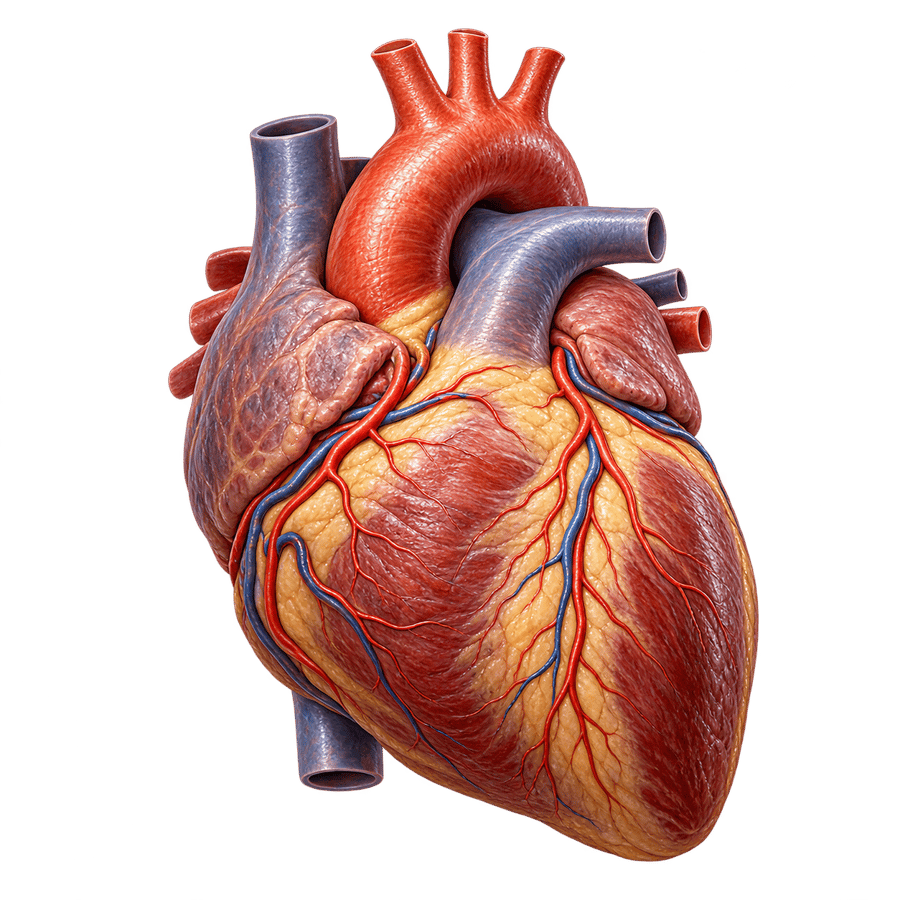
- Your heart has its own pacemaker. A small patch of tissue near the top, the sinoatrial node, fires on its own and starts every beat.
- Left alone, it runs fast. When a heart is transplanted, the nerves to it are cut. The new heart beats faster at rest and varies much less, at least until some nerves grow back.
- The vagus nerve is the brake. It runs to the heart and slows the pacemaker. At rest it’s doing most of the work, which is why a resting heart beats slower than its own natural rate.
- The brake is fast. The vagus nerve acts in under a second, so it can press and let go between one beat and the next. The other side of the system, the sympathetic nerves that speed the heart up, take more than five seconds to act.
- Breathing works the brake. Each breath in eases the brake and the heart speeds up a little. Each breath out presses it and the heart slows. That breathing rhythm is called respiratory sinus arrhythmia, and it’s most of the beat-to-beat variation you see at rest.
- So beat-to-beat HRV mostly tracks the brake. A big swing means the brake is busy. A small one means it has eased off.
The model stops being simple at step four. The two sides of the nervous system aren’t a seesaw where one goes up as the other goes down. One review compares a racing driver who keeps a foot lightly on the brake while accelerating through a corner. Both can be active at once.
Is HRV a measure of stress?
Partly, and less than the apps suggest.
Device makers often describe a low number as stress and a high one as calm. Garmin’s own explainer says lower HRV is “typically associated with elevated sympathetic activity.” The science is more careful. In 2013 the physiologist Billman showed that the ratio once used to measure the balance between the two sides of the nervous system (LF/HF) doesn’t measure it. In 2026 a guideline paper from a group of heart researchers said HRV isn’t appropriate as a marker of the sympathetic side or of the balance between the two.
What it does track is how hard the brake is working, and that responds to many things at once: breathing, alcohol, illness, exercise, late meals and sleep.
How you feel is one of them, and a small one. In 90 people wearing Garmin watches for three weeks, moments they rated as more stressed came with RMSSD about 2.24 ms lower. In 39 adults tracked for three months, days they called stressed came with almost exactly the same overnight HRV as other days, 63.5 against 63.1 ms.
Is a higher HRV always better?
For one person on one device, a higher weekly average usually goes with being rested and fit. But higher on a single night isn’t always good news.
- Training can push it up too. A 2016 review of 27 training studies found resting RMSSD rose a little in athletes who were overreaching, and their performance fell.
- An arrhythmia can push it up. Irregular beats look like variation to a sensor.
- A different device gives a different number. A switch from a watch to a ring changes the number with no change in you, because each one measures differently.
What is HRV not?
- Not your heart rate. Heart rate counts beats per minute. HRV measures how unevenly they’re spaced. They do move together, because the same brake that slows the heart also makes it vary.
- Not a readout of your brain. Gyroscope’s old guide called it a window on the brain. It measures the heart, and the nerves that drive it.
- Not one number. SDNN and RMSSD are two different summaries of the same beats. More on that in how to measure it.
- Not always heart rate variability. Watches and rings time the pulse at your skin, not the electrical beat. Researchers call that pulse rate variability. Garmin says so itself, and a 2026 study of 103 college athletes found the pulse-based RMSSD came in lower than ECG on the same recordings, 81 against 104 ms.
What do the words mean?
The terms you’ll see on devices and in studies
| Term | What it means |
|---|---|
| RR interval | The time between two heartbeats on an ECG, in ms |
| NN interval | An RR interval between two normal beats, with odd beats left out |
| SDNN | The standard deviation of the NN intervals in a recording. How widely the gaps spread |
| RMSSD | The root mean square of successive differences. How much each gap differs from the one before |
| pNN50 | The share of neighbouring gaps that differ by more than 50 ms |
| HF power | The part of the variation that rises and falls with breathing |
| LF/HF | A ratio once used as a balance meter. Researchers no longer accept it as one |
| PRV | Pulse rate variability. The same idea measured from the pulse at the skin, which is what watches and rings do |
The 1996 task force of European and North American heart specialists set the standard definitions of SDNN and RMSSD that studies still use.
16 sources
- Shaffer and Ginsberg, An overview of heart rate variability metrics and norms, Frontiers in Public Health, 2017pmc.ncbi.nlm.nih.gov
- Billman, Heart rate variability: a historical perspective, Frontiers in Physiology, 2011pmc.ncbi.nlm.nih.gov
- Garmin, HRV Status, Garmin Technology, checked 2026-11-10garmin.com
- Awad et al., Early denervation and later reinnervation of the heart following cardiac transplantation: a review, Journal of the American Heart Association, 2016pmc.ncbi.nlm.nih.gov
- Carter et al., Guidelines for rigor and reproducibility of heart rate variability within human cardiovascular research, American Journal of Physiology Heart and Circulatory Physiology, 2026pubmed.ncbi.nlm.nih.gov
- Billman, The LF/HF ratio does not accurately measure cardiac sympatho-vagal balance, Frontiers in Physiology, 2013pmc.ncbi.nlm.nih.gov
- Task Force of the European Society of Cardiology and the North American Society of Pacing and Electrophysiology, Heart rate variability: standards of measurement, physiological interpretation and clinical use, Circulation, 1996pubmed.ncbi.nlm.nih.gov
- Ben-David et al., Pulse rate variability is not the same as heart rate variability, Sports Medicine Open, 2026pmc.ncbi.nlm.nih.gov
- Bellenger et al., Monitoring athletic training status through autonomic heart rate regulation: a systematic review and meta-analysis, Sports Medicine, 2016pubmed.ncbi.nlm.nih.gov
- Takezawa et al., Daily stress and heart rate variability among mindfulness meditation practitioners, Journal of Medical Internet Research, 2026pmc.ncbi.nlm.nih.gov
- Grosicki et al., Real-world effects of alcohol on heart rate, sleep, and physical activity by age and sex, PLOS Digital Health, 2026pmc.ncbi.nlm.nih.gov
- Hirten et al., Use of physiological data from a wearable device to identify SARS-CoV-2 infection and symptoms and predict COVID-19 diagnosis, Journal of Medical Internet Research, 2021pmc.ncbi.nlm.nih.gov
- Leota et al., Dose-response relationship between evening exercise and sleep, Nature Communications, 2025pmc.ncbi.nlm.nih.gov
- Grimaldi et al., Sleep-aligned extended overnight fasting improves nighttime and daytime cardiometabolic function, Arteriosclerosis, Thrombosis, and Vascular Biology, 2026pubmed.ncbi.nlm.nih.gov
- Boudreau et al., Circadian variation of heart rate variability across sleep stages, Sleep, 2013pmc.ncbi.nlm.nih.gov
- Ungaro et al., Disconnection between self-reported wellbeing and heart rate variability from wearables, Sensors, 2026pmc.ncbi.nlm.nih.gov